David Cunningham's excellent discussion of Deadwood as capitalist epic, in which the central subjectivity, in the historical figure of Hearst, is 'capital personified. His soul is the soul of capital. But capital has one sole driving force, the drive to valorize itself...' (Marx) What interests me in Cunningham's reconstruction of this capitalist epic, in which 'heroic' entrepeneurs pit themselves against abstract forces of monopoly and market, is what he notes as the spectral place of the proletariat. If capital is the negativity of pure accumulation then, classically, this would be answered by the negativity of those who have nothing to lose but their chains.
In Deadwood this dialectic is not present or is left hanging; with the Cornish miners and the replacement Chinese workers reduced to mere background. The nascent collective struggles of the Cornish brutally snubbed out as they are reduced to 'bare life' in almost literal forms (as Cunningham details). If Hearst is the figural representative of capital (although the role of his psychopathic assistant Wolcott might be interesting as companion double), then the closest (I think) to a figurative representative of the proletariat is the honest prospector Ellsworth - who is killed by Hearst's men.

This killing, paralleling the assassination of the leaders of the miner's struggles, suggests the elimination of proletarian negativity. Writing on American labour struggles of the 1930s Mario Tronti suggested that 'this red sun that comes from the West' might incarnate a working class defined by the struggle against labour that 'the American class-struggles are more serious than European ones in that they
obtain more results with less ideology.'
In this narrative the lack of mediations produces a sharpened struggle, which was, as Tronti notes, defeated. He also remarks on the withdrawal of American workers from struggle: 'Labor struggles are an irreplaceable instrument of self-consciousness for
capital: without them it does not recognize its own adversary. Consequently, it
does not know itself. And when the contradiction explodes among the parts
altogether internal to the mechanism of capitalist development, again the
workers do not begin to actively struggle, neither to accelerate the crisis, nor
to somehow resolve it.'

What I want to suggest that the double resonance of Deadwood that Cunningham traces in terms of capitalism is also the resonance of the proletariat as absent/spectral in that moment and in the present moment. We could track the present moment of this reflection through the empirical fate of the US working class, traced in Jefferson Cowie's Stayin Alive, or more theoretically through the communization thesis of 'the end of programmatism' (ie, the collapse of the mediating identity of the worker). In either case, if we follow Tronti, we could see the fading of what already were relatively weak mediations. The spectral 'presence' of the proletariat in Deadwood would be this lack of mediation. This would be a dialectic of sharpened negativity, although one that Deadwood raises questions over.
In Tronti's analysis the 'bareness' of the history of the US working class makes possible a new reading of 'this modern sphinx, this obscure enigma, this social thing-in-itself which we
know exists but which cannot be known: the American working class.' Of course, as Deadwood indicates, this bareness, this absence, could also be taken as sign of repression, dispersion, and absence, rather than enigmatic sign of future struggle. This would also be true of the tensions of the communization position, in which the absence of programmes opens out new modes of struggle, but seemingly making it hard to conceive a new 'mass' struggle that would cohere or condense the necessary power to achieve victory - what Tronti calls 'organizational strength'.
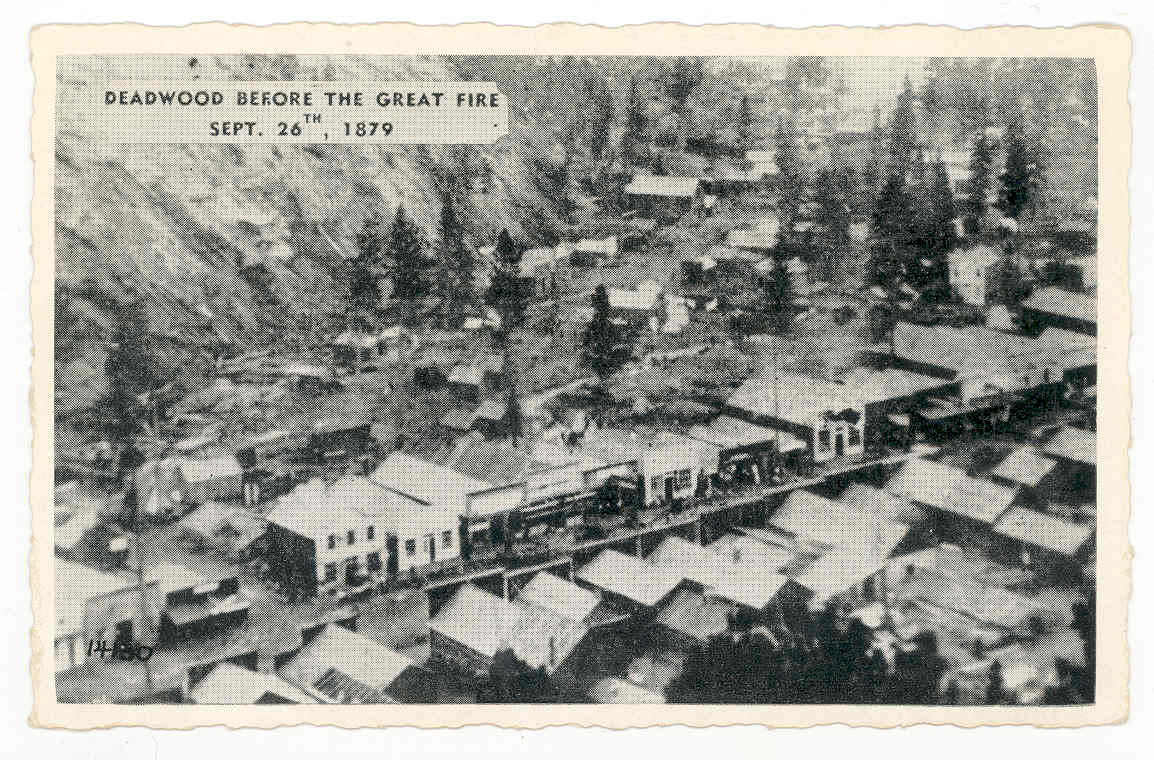
In Deadwood, itself truncated by its own failure as a TV series (in capitalist terms), this violent cutting off of the proletariat - its death - suggests the difficulty of the present moment. A universe of entrepreneurs, corporate and otherwise, an absent proletariat, the dominance of the forms of service work (prostitution, retail, etc.) all trace our own universe, as confined and wretched as the town of Deadwood itself. Of course the historical Deadwood would burn, which is an apocalyptic 'solution'. The fact that this is deferred by the cancellation of the series leaves us within a world that may or may not burn, a universe of the spectre which is not (only) the commodity form but the proletariat, and a universe without solution.


